

How to prioritize
An alternative to the legendary Eisenhower Matrix

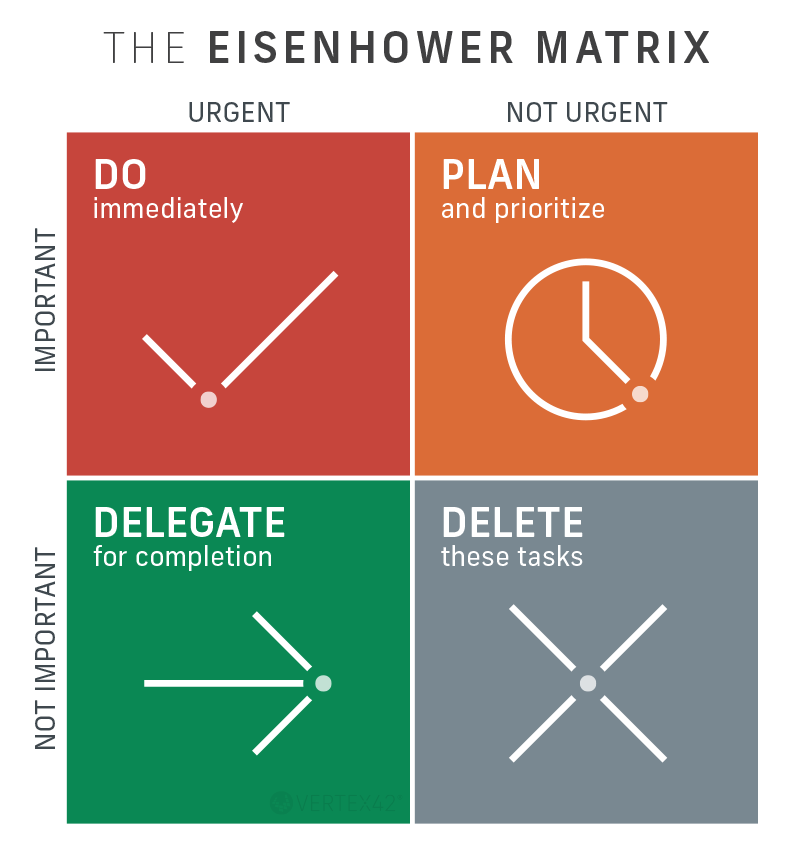
You have probably encountered the Eisenhower Matrix. It has been a staple of time management books and handouts for decades. You have probably seen it in any of hundreds of self-help books or corporate slideshows. And it’s still around: Google executive Laura Mae Martin endorses its usefulness in her 2024 book Uptime: A Practical Guide to Personal Productivity and Wellbeing.
The Eisenhower Matrix seems to have been devised or at least popularized by the esteemed 1990s and early 2000s business author Stephen Covey in response to a 1961 comment by Dwight D. Eisenhower about prioritizing tasks based on urgency and importance. The matrix has squares for categorizing each of your tasks by urgent or not urgent, important or not important. The matrix also instructs you in what to do with the tasks in each category, as summarized in the version depicted above.
With all respect to Dwight D. Eisenhower and Stephen Covey, we encounter some hiccups when trying to map the demands of modern life onto this matrix.
One reason to be immediately suspicious is that Eisenhower made his famous comment about urgency and importance as prioritization metrics while holding an extremely prestigious job (U.S. President) that comes with dozens of secretaries, an entire cabinet of experts to manage and weigh in on various initiatives, and numerous federal departments full of employees, all standing at the ready to have tasks delegated to them that the president deems insufficiently important to do himself. When it comes to the mechanics of getting things done, the person holding the job of president is by default rather privileged.
Different jobs are structured very differently and things change as one advances in rank, but for many of us in today’s workplaces, delegating is rarely a feasible option. If a task is assigned to us, we have to do it, however inane or annoying it is.
Further, the distinction the matrix makes between urgent tasks that are “important” and those that are “unimportant” seems rarely applicable in real life. If something has to be done, it has to be done.
Here’s another concern I have with the Eisenhower Matrix: it encourages us to put tasks in a category labeled “important, not urgent.” This is a prime set-up for procrastination and for underestimating how long a big task will take, then having to work stressfully and intensely on it at the last minute.
Say I’m writing a book chapter that I want to finish in two months. Finishing it is not urgent (that’s two months away), but making steady progress on it is—otherwise I won’t finish it in two months.
So, which category does my book chapter go in?
My fear with the normalization of this matrix as a prioritization strategy is that it pushes us to focus on small tasks due on immediate deadlines, rather than on large tasks with deadlines that are father away. Sure, the matrix tells us to “plan and prioritize” those tasks that aren’t due for awhile, but how do we make sure to actually follow the plan, especially as more “urgent” tasks pop up?
Lately I’ve been trialing the following prioritization system of my own, which I’ll describe here as potential inspiration for you. Do let me know how it goes if you try it. This system abandons the misleading or useless notions of urgent and not urgent, important and not important. Instead, I keep two lists: “big tasks” and “small tasks.” Items on the lists are marked visibly with a deadline. Big tasks are things that take more than 2 or 3 hours to complete (i.e., something I probably won’t complete in one day), while small tasks could take as little as a couple minutes.
Each morning I sit down to decide what I want to try to work on that day. (Do note that I am hesitant to say “to try to get done that day” because this phrasing favors a focus on small tasks that can be fully completed.) Importantly, I choose tasks from both lists, provided my schedule allows, and I aim to work on both throughout the day, even if my plans are disrupted.
More detail is warranted on the complexities of this way of approaching big tasks, but I’ll pause that conversation for now. I’ll leave you here with the categories of big tasks and small tasks, none of which are unimportant and all of which are urgent in their own way. Making progress on both kinds of tasks is essential for most of us.
Have we considered that these matrices are a form of procrastination in themselves?